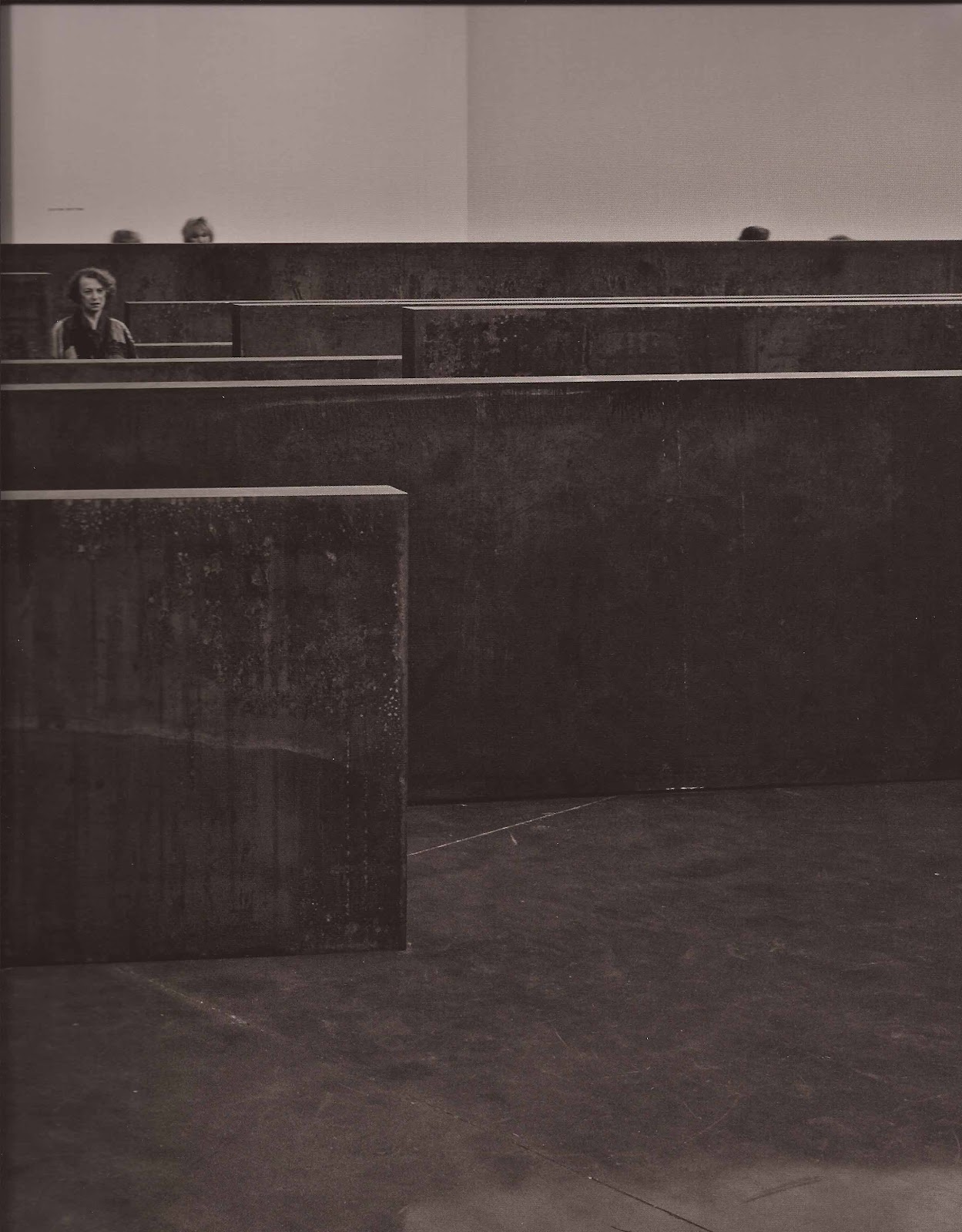
(published in 2006 by Gagosian Gallery, NY).
Dotted Line Journal
Wednesday, 23 May 2012
Richard Serra
All images are from "Richard Serra - Rolled and Forged"
(published in 2006 by Gagosian Gallery, NY).
Labels:
Richard Serra,
Scuplture
Tuesday, 8 May 2012
Thursday, 8 March 2012
Sandra Eterovic | A Small Space
A Small Space ran by artist Peter Summers is the tiniest shop you can find in Fitzroy.
The shop is part of a vibrant French cafe called La Niche (67 Smith Street).
This month’s feature artist is Sandra Eterovic. Sandra’s installation is imaginative and beautiful. The Inspiration Wall on the left hand side shows her thought process and her love for colour and detail.
The shop is part of a vibrant French cafe called La Niche (
This month’s feature artist is Sandra Eterovic. Sandra’s installation is imaginative and beautiful. The Inspiration Wall on the left hand side shows her thought process and her love for colour and detail.
Labels:
A Small Space
Wednesday, 7 March 2012
Abstract Group Exhibition
Tim Gresham from the studio is having an exhibition at Subject Matter Art Space. Opening night is tonight from 6 - 8pm.
Monday, 5 March 2012
Wang Shu | Winner of 2012 Pritzker Prize
I am very excited by the news that Wang Shu (Amateur Architecture Studio) was awarded this year's Pritzker Prize. He is the first Chinese architect to receive such a prestigious architecture award.
I remembered attending a lecture he gave at theUniversity of Melbourne . He explained that to him architecture is about everyday life. Practicing architecture can be considered as a having hobby. By doing that, one can be free from of being too rigid and thus lose one’s spontaneity. That was the reason he called his office Amateur Architecture Studio.
When I went to the Shanghai Expo in 2010, Ningbo Tengtou Pavilion was a standout. From far the building looked like a modernist cube. While moving closer, one realized Wang Shu used traditional vernacular building technique (like tiling, brick laying and use of bamboo) to tell a different story. The form was western yet the planning and materials used were typically Chinese. It had a courtyard in the middle where a rice field was inserted. A giant fish tank was used as a threshold. The building used passive cooling method to bring the wind in via the giant holes on the wall, which significantly reduced the indoor temperature. It was the one of the few pavilions that did not have an air-conditional unit.
I hope Wang Shu’s win will herald a new chapter in Chinese architecture.
I remembered attending a lecture he gave at the
When I went to the Shanghai Expo in 2010, Ningbo Tengtou Pavilion was a standout. From far the building looked like a modernist cube. While moving closer, one realized Wang Shu used traditional vernacular building technique (like tiling, brick laying and use of bamboo) to tell a different story. The form was western yet the planning and materials used were typically Chinese. It had a courtyard in the middle where a rice field was inserted. A giant fish tank was used as a threshold. The building used passive cooling method to bring the wind in via the giant holes on the wall, which significantly reduced the indoor temperature. It was the one of the few pavilions that did not have an air-conditional unit.
I hope Wang Shu’s win will herald a new chapter in Chinese architecture.
Monday, 6 February 2012
Thursday, 24 November 2011
On Paper Model
These are the models I made over the years. While putting the image together, I realised that almost all of them were made by paper and cardboard.
Paper is my favourite modelling tool. A lot of the concept can be quickly materialized by cutting, folding and gluing a piece of paper together. An ambiguous shape can be much more evocative than a definite one. Space, light and shade can all play a part in defining movement and stillness within a place.
Subscribe to:
Posts (Atom)